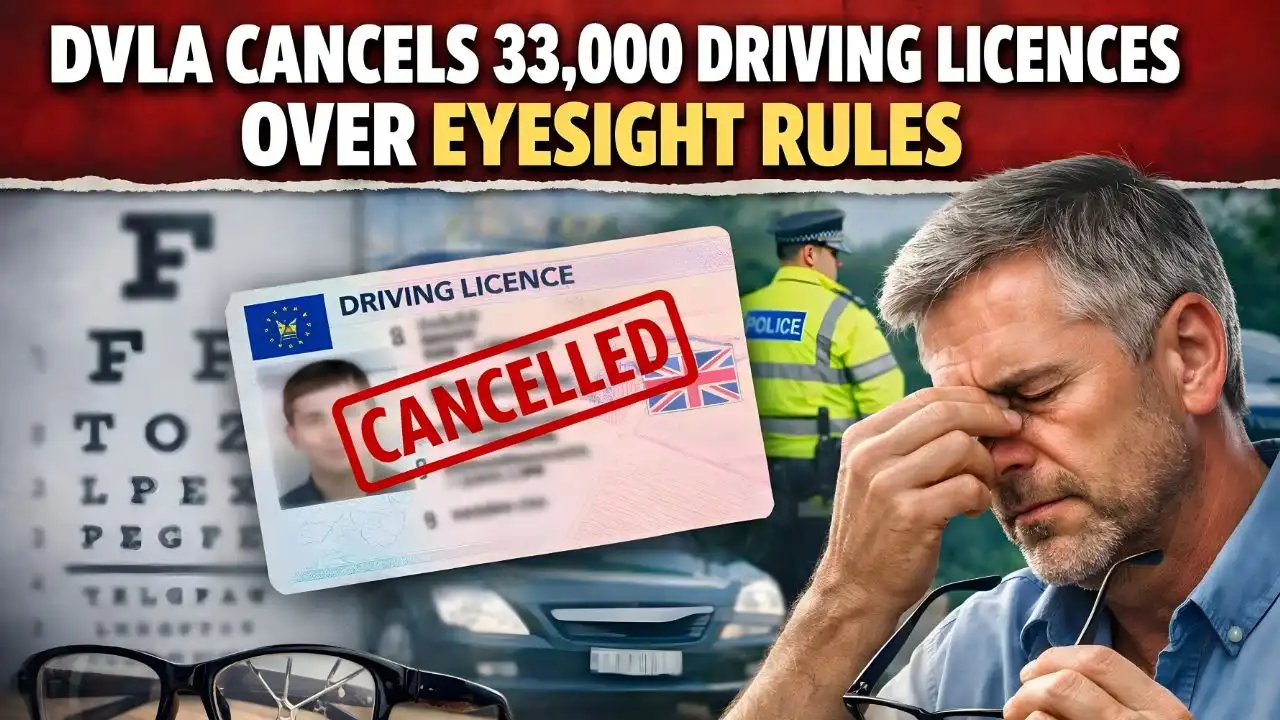
Driver and Vehicle Licensing Agency (DVLA) have terminated 32,944 driving licenses in the UK, due to an extensive operation to ensure road safety, causing disgruntlement of many drivers, mainly older ones.
The reason why the cancellation happened
The principal reason for all that cancellation was probably an exacting standard of eyesight.
According to data extracted from Freedom of Information (FOI) Act responses, the authority took away, or at least refused to renew driving licenses of 32,944 people in a four-year time frame after they were found to have failed in meeting the legal eyesight standard required to operate a vehicle safely.
The UK’s law dictates the obvious requirement that a driver must have good vision in order to drive. And when the eyesight became below what is considered safe, the agency’S Statement of Driver’s Medical Fitness offers provisions of either revoking or refusing a license.
The basic rule every driver must meet
Quite simple are the legal requirements in connection with eyesight:

A driver must be able to read the license plate of a standard vehicle from a distance of 20 meters….
There is no way one can be allowed to drive legally after failing this mechanical eyesight test, however confident he may feel they might feel while driving.
Who experiences the greatest hit
Although vision issues might be said to hit everyone, statistics reveal that the highest impact has been felt by the elderly who take to the wheel.
Marcello, with the age group between 70 and 79, holds the record for the highest number of driving licenses that have been taken away from him- and on the next level, come octogenarians and nonagenarians.
The trend is due in the main to age-related degenerative conditions such as cataracts, glaucoma, and macular degeneration-things that lessening visual acuity as time goes on.
The reason the problem is growing rapidly
One of the major issues when it comes to eyesight is that it deteriorates slowly and so imperceptibly. Drivers adjust their driving behaviors without knowing their vision is not what it was. Increasingly, therefore, there is a gap between their perception and their actual driving performance.
The intervention, in most cases, comes through reports by doctors or opticians; this is in contrast to direct reports by drivers to the DVLA.
In the UK, drivers are legally obliged to inform the DVLA of the development of any medical condition that would affect their driving, including vision.

Consequences of non-report
Fines or penalties could be applied or, in the most serious cases-after accidents-of outright prosecution, if a driver fails to disclose such conditions.
BEASTS FOR NEW INSTRUCTIONS AND DEMANDING CHECKS
Authorities are now planning to introduce tougher regulations for older drivers. One major proposal includes:
Mandatory eye tests at every license renewal for drivers older than 70
At present, drivers older than 70 are required to renew their licenses every three years, and this is largely a self-declaration system.

The new rules may require drivers to present proof that their eyes have been checked recently, which might mean easier cancellations of licenses in the future.
The Safety-Independence Dichotomy
The license expiration is much more than an inconvenience. Many older citizens have found that having a license means independence, mobility, and quality of life.
However, officers believe that the first precedence should be given to road safety. Poor vision reduces reaction time, distance judgment is off, and the chances of falling into serious accidents rise.
What drivers can do about this situation
It, therefore, underscores the importance of getting their eyes checked regularly. Again, most experts highly recommend anyone going for eye analysis at regular intervals, with or without overt signs.
Drivers should take notice of warning signs that can include things like blurred vision, not seeing well in the dark or problems with reading road signs. Early detection can mean that the loss of their driving licence can be avoided with the cause of some treatment.
Conclusion
The cancellation of nearly 33,000 driver’s licenses provides a clear warning about how the eyesight are beginning to be the focus of attention as far as road safety enforcement is concerned. While tough measures have been advised, it means it is much more clear that there is considerable concern for the risks of driving with impaired vision.